






The Weekender

It's all the boat you need!


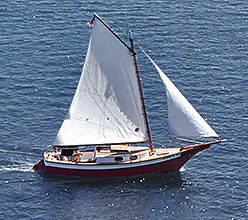
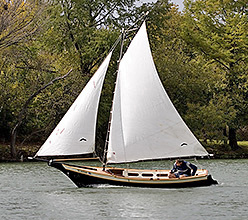
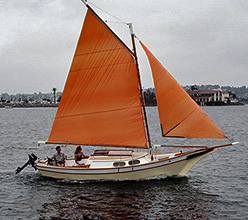
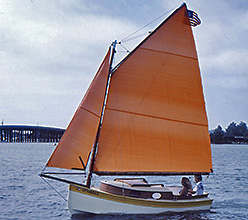
The WEEKENDER is a boat that borrows some good ideas from the golden age of working sail, as well as some new wrinkles from space-age materials and power systems. It's a project that combines the best of both worlds-the classic lines of the sea-wise sloops of the turn of the century-and the quick-to-build, lightweight, low maintenance of modern materials.

What would one of the old master boat designers do with modern tools and materials? That was the question we set out to explore when we designed the first WEEKENDER as the featured boat plan for Popular Science magazine back in 1981.
We went with a simplified, stressed-skin plywood box-section hull that eliminated almost all the intricate inner framing of the old boats.
The result was an extremely rigid, self-aligning structure that pulls itself straight as you build. This worked great for reducing building time, but it also had some other bonuses that we weren't expecting.


Inside, there's over six feet of sleeping room for two (It's true. We got a letter from one couple who spent two summer vacations on their WEEKENDER without a divorce). The reason for the extra room inside is the absence of a centerboard trunk that usually sits square in the middle of where you want to be.
The very first WEEKENDERS had a centerboard that slipped down out of the full-length keel. But then we began to get letters from builders who were leaving the centerboard off-and wondering why we'd used it in the first place. They were still getting good performance to windward, and the boat still tacked on a dime.


We went back and retested without any board in place. They were right. The shallow full-length keel and the hard chine of the hull bottom bit into the water and kept the boat sailing well into the wind. We could find only one condition it seemed to have trouble handling: sailing to windward in very light airs. Then someone remembered to induce the same angle of heel the boat would have in a breeze by sitting on the downwind side of the cockpit, and the boat took off upwind on the spot. So, with one little sailing trick, we can forget about centerboards that take up cabin room, that get caught in the kelp, and that leak and cause drag. We can let the kick-up rudder kick up, and then sail right up on a beach without touching another line.


Hull-building is just like building a plywood box. In fact, it is just building a plywood box. After nailing together the keel, we cut out the deck, bottom, and bulkhead parts, assemble the deck and bottom, screw the bottom down onto the keel, then fit the bulkheads and deck down in place. If we keep the centerlines of the parts lined up, there's no way the boat can come out lop-sided. And once the side panels are screwed to the edges of the deck and bottom, the whole box-section becomes extremely rigid. Inside, parts like seat-bottoms and shelves double as side-framing. You'll find a lot of parts on the WEEKENDER doing double-duty. That's what keeps it light.


The WEEKENDER'S shape has a lot in common with one of the most seaworthy boats on the water, the Grand Banks Dory (with an added keelson and bowsprit). So she can handle some pretty nasty waves without making a big deal about it, and she's a nice, dry boat in the cockpit as well.
The salty old gaff-head sail rig also turned out to have a lot of advantages we weren't prepared for. With the mainsail held on three sides by spars, it's easy to control the shape of the sail while underway-and it's also easy for home-boat-builders to make their own durable sails that really work. And just because we usually see gaff-head rigs on slow old barges doesn't mean they can't sail. Some of the fastest sailboats in history, as well as some incredibly rapid ice-yachts have used gaff-rigs.
But when we launched the first WEEKENDER, we ran into the trade-off of the colorful gaff-headers; set-up time. The old rigs could take a lot of time to get ready to sail. Then we worked out a folding mast which solved all that. Now set-up time is just a few minutes, and all we have to do to pack the boat away for trailering after a sail is to unhook the forestay, lay the mast back down over the lowered mainsail, and stuff the jib (still attached to the forestay) down into the forward hatch. Not a sail or line has to be removed.


All this, including rigging and sailing speed-secrets, along with all the building steps, is covered in the new over 3 hour Video Home Boat Building Course that goes into tool-use techniques, painting tips, even how a beginner can handle giving the boat a protective coat of fibreglass for low maintenance-even making your own steering wheel if you can't find one in a nautical shop. Although the whole boat can be built from standard lumberyard stock and hardware, using common hand tools, a lot of WEEKENDER builders like to upgrade their craft with the latest in racing gear and custom-made sails. So the Video goes into tips about upgrading your boat; what we think is worth the extra money, and what may not be.

Included with the Video Home-Boatbuilding Course are the complete building plans with progress drawings and construction photos, materials list, a Sailing Log for the boat, and access to a Builder-Hotline so if a step still seems hazy after watching it on the tape, seeing it in the plans, and reading about it in the complete step-by-step assembly guide, you can get to the sympathetic ear of an expert WEEKENDER builder to get the help you need.

We've had more letters and photos from WEEKENDER builders than just about all the other boats we've designed for the nation's top magazines combined; everyone from charter schooner captains to a fifteen year-old who built and sailed his WEEKENDER without any adult "help". Because we deal with a lot of first-time builder-skippers, we try to stay away from too much sailing mumbo-jumbo and boaty-talk to try to impress you with how salty we are. We've sold over a third of a million DIY plans, and we know how important it is (for everybody) to try our best to answer every question before it has to be asked. We've also found home-built boat people to be about the nicest crowd we've dealt with, and we hope you'll want join them-building your own little freedom-machine, and then sailing with us for some good, fun adventures on the water.


L.O.A.: 19'6"
L.O.D.: 16'
BEAM: 6'
DRAFT: 3' (1' w/RUDDER UP)
HULL WEIGHT: 550LBS
SAIL AREA: 120 SQ.FT.
SLEEPS TWO COSY, ONE EASY
CREW; ONE TO FOUR
OPTIONAL POWER TO 5HP OUTBOARDS, 45 LBS ELECTRIC
COST TO BUILD: FROM UNDER $1600


Plans are $35 and the Plans and 3 1/2 Hour DVD Set are $90!


Weekender Sails For Sale!
We have sets of nice Dacron sails to upgrade your Weekender.

If you're in the mood to watch a project building in action, go to ProjectCam!


Some of you may have more questions about the Weekender and the plans. If so, please Click Here to view the Frequent Questions Page.

If you are considering building a Weekender (or a Vacationer or Pocket Cruiser), we suggest you take a look at the Weekender Builder Bulletin Board page for some photos of people's Weekenders, and the web pages posted by Stevenson Projects Builders. These web pages have lots of Weekender information, links to builder's pages and e-mails, tips on materials, and lots more.
Click here to find these pages.

One of the very best resources for people building ANY of our boats (or considering building one) are the two Builder Forums. These are run by and for builders of our boats and they're huge sources of information for the novice as well as the seasoned builder.

Click Here to see photos of a Weekender built in Hawaii!

Click Here to see more photos of Weekenders sailing in San Diego.

If you are trying to decide between the Weekender and the Pocket Cruiser, we have a good solution for you! You can now download the free plans and patterns for great little paper Weekender, Vacationer, and Pocket Cruiser models. These will give you a feel of the different sizes and shapes of the two boats and help you decide which one fits your needs best.

Click Here to go to the Model Page, there you will find the links for the Paper Pocket Yachts.


The Vacationer

The Vacationer grew out of the Weekender; people had been asking for a larger model, so we forged ahead. The Vacationer turned out 21' on deck (24' overall), with the same type of shoal draft, full-length keel and clipper bow that worked so well on the Weekender. She has built in camping fixtures and a more rakish cabin than the Weekender. The Vacationer is a pretty good-sized boat, with a nice smooth sailing feel to match. A Weekender for the whole week.

A lot of little improvements were developed in the earlier Weekender (after the first magazine release), and then incorporated into the later Vacationer. Now that we've re-done the Weekender plans with all these improvements worked back in, the Vacationer is a little redundant for most people. The Weekender does almost everything that the Vacationer can, is far less trouble and expense to build and fit out, and takes up less room. A lot of people are ordering the Vacationer lately, and more power to them, but we prefer the Weekender personally. These caveats aside, the Vacationer is a great boat.

To take a look at more photos of the Vacationer, including interior shots, Click Here.


We have recently posted a page with photographs(including good interior shots!) of a very nice Vacationer built by Mr. Donald Lassiter of North Carolina. Click here to see this page.

L.O.A.:24'
L.O.D.:21'
BEAM:8'
SAIL AREA: 193SQ.FT.
WEIGHT: 750LBS
CREW:ONE TO FIVE
SLEEPS TWO COMFORTABLY
OPTIONAL POWER TO 5HP.

Since the Vacationer is built in much the same manner as the Weekender, people have asked if we sell the Weekender Video with the Vacationer plans. Certainly...to order the Vacationer plans with the 3 hour WEEKENDER Video, send $82 and ask for Vacationer Video Package.

Plans are $35 and the Plans and 3 1/2 Hour DVD Set are $90!


Click Here to take a look at a drawing of the Vacationer building sequence, and to see the basic lines of the hull. The Vacationer is similar to the Weekender, so this drawing has some value to the prospective Weekender builder as well.

 We've put up a page of pictures of a Vacationer built by Mr. Taylor. We like these pictures so much we decided to put a link to them out on this page. You can find more Vacationer Builer Pictures in the Builder Pages.

Click Here to go to the Model Page. There are now three Paper Pocket Yachts you can download freee and build tonight: A Vacationer, A Pocket Cruiser, and a Weekender!


A Builder sent in his version of our magazine layout (ours is on the left). Which has the nicer lines? You be the judge.

The Pocket Cruiser

The Pocket Cruiser was designed to be roomier than the Weekender, without having to get into a bigger project. The Cat-boat style hull is only 14' on deck, but has a 6' 9" beam and a fairly high cabin which provides a lot of interior space in such a small boat. This also makes for a very stable boat, with lots of payload for more family action. The Pocket Cruiser is a good boat, with slightly more modern lines than the Weekender and Vacationer, but also a bit slower (however, that beam can really handle the breezes, and when it pipes up, she'll fly along barely heeled over). The Pocket Cruiser can also double as a motor launch with the rig removed.

To take a look at more photos of the Pocket Cruiser, including interior and motor-launch shots, Click Here.


L.O.A.:17'6"
L.O.D.:14'
BEAM:6'9"
SAIL AREA: 137SQ.FT.
WEIGHT 550LBS.
CREW:ONE TO FOUR
SLEEPS TWO COMFORTABLY
OPTIONAL POWER:TO 5HP, 45LBS ELECTRIC

Plans are $35 and the Plans and 3 1/2 Hour DVD Set are $90!


Click Here to take a look at a drawing of the Pocket Cruiser building sequence, and to see the basic lines of the hull.

To get a good feel for the shape and arrangement of the Pocket Cruiser, you can now download and build a little paper model to compare with the Weekender!

Click Here to go to the Model Page, there you will find the links for the Paper Pocket Yachts, as well as a nice look at other models builders have made (including a nice look at a Pocket Cruiser model which shows the bilge boards well).


If you're looking for a theme to build your Pocket Yacht around, here's a link to a great group of Piratically Minded scoundrels who might have some ideas for you! If you feel like taking to the high seas in search of plunder, this group can give you a good heading. They keep a weather eye out for trouble (so they can they be sure and get in the thick of it!), and do a good job of keeping their brethren informed with the newsletter "No Quarter Given". They maintain a site with links to sources of gear and other like-minded groups.


Click Here to get in touch with them!


Send us an e-mail

Call Us at 650.873.0216


Back To The B.Y.Y.C. Homeport
