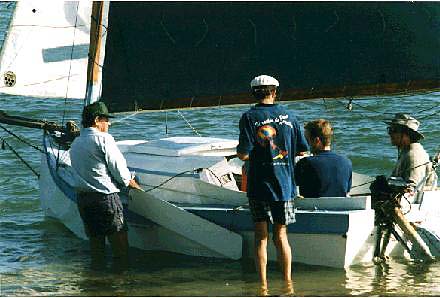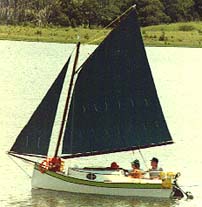
Mr. Treloar sent us the e-mails below along with his photos. We thought everyone would enjoy reading about his Pocket Cruiser and its history.
Many years ago we
received the photo on the left from the original builder, Mr.
Davies. Mr. Davies built this Pocket Cruiser in 32 days (he also
built a Triad in 11 days...). Mr. Treloar now owns the boat, and
we'll let his e-mails give you the rest of the details!
Hello
again from Chris Treloar in Australia. Thanks for the reply regards
my
pocket cruiser. I found the original builder through your sight.
He is John
Davies and only lives 30 miles away. He was extremely pleased
to see that the
boat had been rebuilt. He now owns a Phil Bolger micro. It is
testimonyto the
strength of your design because even though he built it very quickly
he
unfortunately built it to cheaply and a bit rough. He used packing
case plywood
which was used for shipping Volvos to Australia. He used all steel
screws and
resorcinal glues. The bottom was done in polyester. He said he
would have done
it in epoxy but it was very expensive and not easy to find back
then. Even
though the boat was built rough it has done one hell of a lot
of sailing. He
has been caught out in 70 knot thunder storms and has quite regularly
sailed it
in 30 knots plus. He sometimes used to go cruising for 2 weeks
at a time with
his wife and 2 dogs. When he sold it there was no known rot in
it. The person
who bought it never did any but the most basic maintenance. When
the bottom
started to rot he repaired it with masonite and house bog. He
lived aboard it
for 3 months and sailed it on a 500 round mile trip up the coast
of Queensland
from Brisbane to Bundaberg and back. He never carried an outboard
as he didn't
believe in them. When he use to do these trips the boat was falling
apart. The
only thing that kept the bottom together was the polyester sheathing,
and it
was also the polyster that caused the problems as people have
found out now it
might be cheap but it doesn't stick to the wood and lets the moisture
in. I
highly recommend that people don't try to do a boat as cheap as
they can as you
pay the price later down the track. I don't use marine ply as
the Australian
exterior ply is of very high quality and uses the same glues and
is a lot
cheaper. I highly recommend epoxy regardless of the price. The
American System
Three brand is excellent as it is very forgiving especially of
atmospheric
condition. Their glue is excellent, It will even go off properly
in the wet and
the cold doesn't seem to bother it.
When I bought the boat it was in a sad way. I had to replace half
the sides
from the transom up on both sides. 1/3 of the bottom, one side
of the cockpit.
The whole keel had rotted outso I laminated one out of pine and
heaps of
stainless screws and epoxy flat onto the bottom of the boat and
when it was
close to the right size I shaped it with a spoke shave an sander.
I covered all
the bottom and transom with double diagonal cloth and epoxy. A
small part of
the decks needed replacing and I also did the deck hull in cloth
and epoxy. The
post fot the mast had also rotted so I replaced that with laminated
pine and
strengthened up the deck where it goes through. I also had to
replace the
tabernacle. The rudder box was falling apart so I just rebuilt
it and stiffened
it up by using hard wood. The mast was falling apart and had a
twist in it
but luckily I was given two 26' long very old perfectly straight
grained
douglas fir flagpoles. I now have enough for 4 masts if I need
them. The
rigging was also replaced. The cabin top was also replaced as
well as the
windows. This might sound expensive but it only cost around $900
which also
included getting the trailer repaired. It only took time because
I had no
advice or anything to work. The boat is still rough but it is
strong and rot
proof and everone loves it. I use an old Seagull outboard as I
am rather fond
of the dirty smelly noisy things. I have entered the boat in classic
regattas
and reenactmaents
and gaffers races. Even though it might be rough people like it
because it is
obviosly not a show boat but one that gets used. I don't worry
about knocking
it around as I treat it like a work boat. The lee boards are made
out of steel
and are very simple to fit. After all the trouble I had with the
boat at the
beginning and all the worries we named it TITSAWORRI.
Its a credit to the strength of your design as it was still being
sailed very
hard and very regular even as it was falling apart. None of the
problems I have
had have been due to your design but due to poor workmanship.
So tell people
not to try to make it a challenge by doing it to cheap by using
poor quality
materials as it is an excellent boat and deserves to be treated
with respect.It
still gets used very regularly
and still cops a hiding in bad weather. Thank you for a great
design.

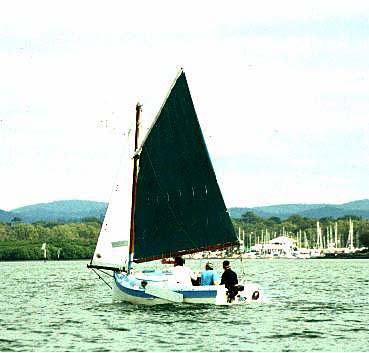
Hello from Chris Treloar,
I thought you might like another photo of TITSAWORRI. Its taken
at the
beginning of a fun race on a classic boat regatta. The old boat
held her
own on the down wind mark and on the reach but got a bit left
behind to
windward, but that got sorted out by getting someone to go right
up on
the bow and getting the nose dug in. It always makes a difference.
I am
slowly learning the protocol on the bulletin board, it is all
new to me.
Regards Chris.
It is blowing about 40 knots here today so no sailing. Unusual
weather
for here