Uncharted waters
First-timer takes
'Stolen Moments'
to build a dream
JIM ROGALSKI
Saratoga County Bureau Chief
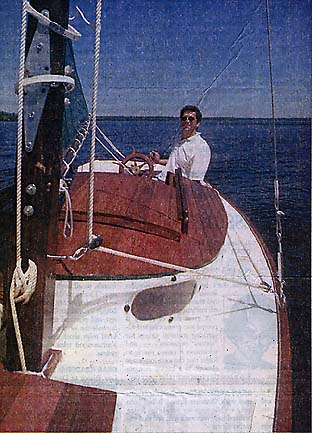
I say this confidently, having recently whelped a 19-foot wooden sloop.
When I disconnected her trailer winch and eased her into Saratoga Lake for her maiden voyage, I felt intense relief that after six months of toiling in my unheated garage, I had created something that actually stayed afloat.
No words were so confirming as those of a salty-looking gent with a white beard, sailing a sleek 16-foot Fiberglas sloop on Saratoga Lake recently. He positively beamed when he said, ``That is a gorgeous boat. She looks absolutely beautiful on the water.''
My objectivity was gone, but such a declaration from a stranger is magnificent.
|
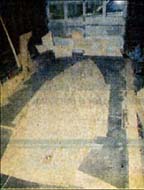
Stolen Moments came together in Jim Rogalski's unheated garage. The keel, at left, upon which everything else is built and the cut-out floor and bulkheads ready to assemble. |
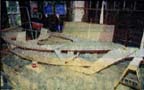
A Three Dimensional boat takes shape. The deck and bulkheads are in place on the keel. Construction of the coclpit seats is next. |
Applying Fiberglass cloth to the hull; coated with resin and sanded smooth it makes the boat watertight. |
The Finished product: Stolen Moments in Rogalski's Saratoga Springs driveway ready for launch. |


A popular hobby
Thousands of men and a growing number of women are smitten with the romanticism of building their own seafaring crafts. This garage-based armada of Ishmael wannabes is building everything from simple plywood rowboats to elegant cedar-strip canoes and kayaks, to 40-plus-foot-long double-masted ocean cruisers.
``The vibrancy of home boat building is strong,'' said Tom Jackson, associate editor of the bi-monthly Wooden Boat magazine. The publication reaches 110,000 subscribers worldwide, a number that has grown steadily in its 25 years. Men far outnumber women in the hobby, Jackson said, but ``as more women take up sailing and rowing, more are building their own boats.''
Internet sites and chat rooms on boat building abound (see box) and the myriad plans available in Wooden Boat magazine offer the first-time skipper/builder options, support and motivation.
``Finishing it out, launching it and seeing it come to life is an enriching experience,'' Jackson said. ``But to put a number on it (the number of people building boats) would be almost impossible. There are just so many in their back yards and garages."
I can put one number on this nautical subculture: 10,937.
That's how many Web pages came up when I did a simple search for ``boat building'' while I was still conceiving the idea. Design and plan options abound. Garage skippers' personal Web pages are everywhere, proudly detailing their boat building experience from first cut to launch.
Like many of the backyard skippers, I'm sure, I built my boat driven by some primordial urge to take to the water. All I know is I needed to build a boat. I needed to. I can't explain it any better than that.
Choices to make
The two most crucial steps in building a boat have nothing to do with choosing the wood, glue and rigging. They are naming her, then finding a deserving place to launch for her maiden voyage. If she goes down, you want her resting peacefully, although such a fate is unlikely given the advent of waterproof epoxy and Fiberglas (sic) coating.
But why are all boats female? Jackson wasn't sure. ``It's just a longstanding tradition for as long as anybody can remember,'' Jackson said. ``In fact, even in the height of the industrial age of sailing ships they were named after men, but still called she.''
I christened my craft Stolen Moments, for the name best describes how I built her: an hour here, 20 minutes there. A total of about 150 hours over six months -- an average of 6.5 hours per week-- stolen mostly in the evenings after the kids were put to bed, and double-time on Saturday mornings, a deal my wife and I worked out.
The design I chose is called the Weekender, from Stevenson Projects (www.stevproj.com). This cabin sloop caught my eye for its classic lines, lovely curves and ease of transport (a standard bass boat trailer). But the simplicity of the flat bottom with stem-to-stern keel construction is what hooked me into believing I could actually do this. (That and testimony from a 14-year-old boy who says he built one completely by himself. Talk about a motivator for a 38-year-old.)
No steaming of wood; no bending ribs. You can buy everything for this boat, Stevenson proudly professes on its Web page, at your local hardware store and build it with basic shop tools for less than $1,500. Polypro tarps for sails; standard high-grade plywood; 4-inch round PVC pipe sliced into quarter-inch thick rings for mast hoops.
Duct tape.
Now that's my kind of boat!
Plans and video: $74.
I cut a few corners (less expensive wood and Fiberglas on the hull only) since my sailing will be limited to freshwater lakes in a short, Northeast summer season. The cost was a little more than $1,000--not counting the trailer.
On the water
When I launched her the first time, my modest investment proved everything a neophyte captain could want. She runs with the wind with speed and dignity, changes course like a marlin, and beats to windward with nose-to-the-grindstone determination. If she carries any limitations, they lie only in my shortcomings as a skipper.
When she wants to run I let her heel 15 degrees, sit on her rails and lean back to give her the delicate balance she needs for maximum performance. When she greedily pushes for 20 degrees and the opposite rail is touching water, I loosen the mainsheet to take a bit of wind from her sails, and settle back into the groove that I'm comfortable with. As we grow together, I will doubtlessly give her more freedom.
When the sun and mist kiss my face, the cold winter months in my garage are but a distant memory.
What remains seeps refreshingly deep into my soul: the smells and sounds of water playing with the hull, the sight of polished mahogany glistening in the warm sun, the smooth sounds of ropes gliding across pulleys and wind filling her sails, and the intense satisfaction that I have reached port after a six-month journey on previously uncharted personal waters.
|
|
Internet addresses of interest to first-time boat builders:
|